


MEASURING OUR IMPACT TO ACT BETTER
At SIPH, we are convinced that we have a role to play in the fight against global warming. This is why since 1997, we have made the environmental subject a major focus of our sustainable development policy.
Because it is essential to act, to evaluate and quantify our impact, we regularly measure our GHG emissions on our rubber operations in Côte d'Ivoire, Ghana, Liberia, and Nigeria, from the value chain ranging from plantations through to factory processing and export to international markets.
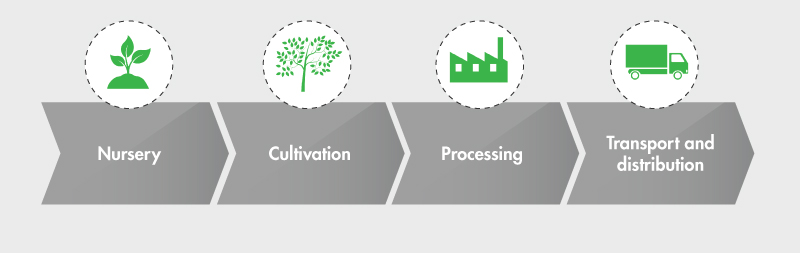
Emissions reporting follows the Product Life Cycle Assessment methodology established by the Green House Gas (GHG) Protocol. The emissions calculator we use was developed by MEO Carbon Solutions, an environmental consulting company, in collaboration with our industrial partners SOCFIN and Michelin.
Download the full press releaseOUR GREENHOUSE GAS (GHG) EMISSIONS
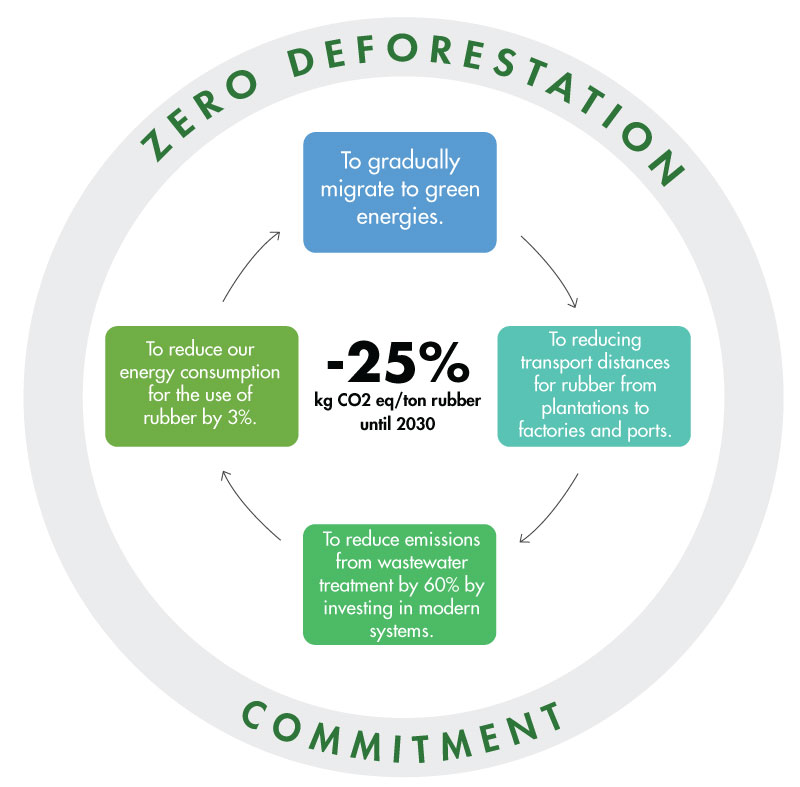
SIPH has been committed to a ZERO DEFORESTATION and ZERO BURNING policy since 2016 and follows the HCV/HCS (High Conservation Value / High Carbon Stock) methodology.
368 kgCO₂eq per tonne
- In 2024, we emitted 362 kgCO₂eq per tonne of rubber produced.
- We recorded a 1.7 per cent increase in total emissions per tonne, due to an expansion of the reporting scope, notably improved comprehensiveness in the calculation of CO₂ emissions from effluents, fossil fuels and other agricultural inputs.
Nature of emissions
- 50 per cent of emissions arising from direct energy consumption (Scope 1), due to the increase in business volumes and the associated fuel consumption.
- 23 per cent of emissions fall under Scope 2 ; these relate to the indirect purchase of electricity from the national grid.
- 27 per cent of emissions fall within Scope 3; these are attributed to upstream and downstream transport and the procurement of materials across all systems.
Table showing GHG emissions per tonne by subsidiary in 2025
| Subsidiaries | Machined output in tonnes | Emissions in kg CO₂eq per tonne produced |
| SAPH | 308 000 | 367 |
| GREL | 54 970 | 364 |
| RENL | 5 015 | 360 |
| CRC | 31 054 | 558 |
| Total SIPH | 399 039 | 368 |
Based on the available industry benchmarks, the SIPH Group’s carbon footprint is among the lowest in the natural rubber sector. This performance is largely due to measures to reduce consumption of energy, fertilisers and pesticides, ongoing energy conversion projects, and the low emission factor of electricity in several of the Group’s countries of operation, notably in Côte d’Ivoire.
Our actions to reduce the main sources of GHG (Greenhouse Gas) emissions
Scope 1: direct emissions
The Natural Rubber division’s decarbonisation strategy is based on a combination of measures aimed at reducing direct emissions linked to its industrial and agricultural activities. It includes a target to reduce pesticide use on plantations by 70 per cent, measures to continuously improve the energy efficiency of factories, and the exploration of a solution to produce biogas from effluent treatment ponds. This project, which is scheduled to come on stream by 2028, will ultimately enable LPG to be replaced by renewable energy. These measures support the division’s ambition to reduce its greenhouse gas emissions by 20 per cent by 2030, compared with the 2023 baseline year.
Scope 2: Energy consumption
In order to reduce indirect emissions linked to the purchase of electricity, we are continuing our transition towards an energy mix that increases the share of renewable energy. This approach is underpinned by the gradual roll-out of solar farms at several of our sites, including an initial installation already operational in Bongo, which covers up to 15 per cent of the plant’s energy requirements. This programme will be gradually extended to other industrial units in order to increase the share of renewable energy in our operations. Furthermore, we consistently request a Guarantee of Origin (GO) from our suppliers to certify that a proportion of the electricity purchased from the grid has been generated from renewable energy sources.
Scope 3: indirect emissions
The strategy for reducing Scope 3 emissions is based on optimising the upstream and downstream value chain. With this in mind, a working group has been set up to review the methods used to transport rubber and to prioritise lower-carbon logistics solutions. The work focuses in particular on the flows between plantations and factories, as well as between factories and ports of shipment, with the aim of gradually reducing transport-related emissions throughout the value chain.